
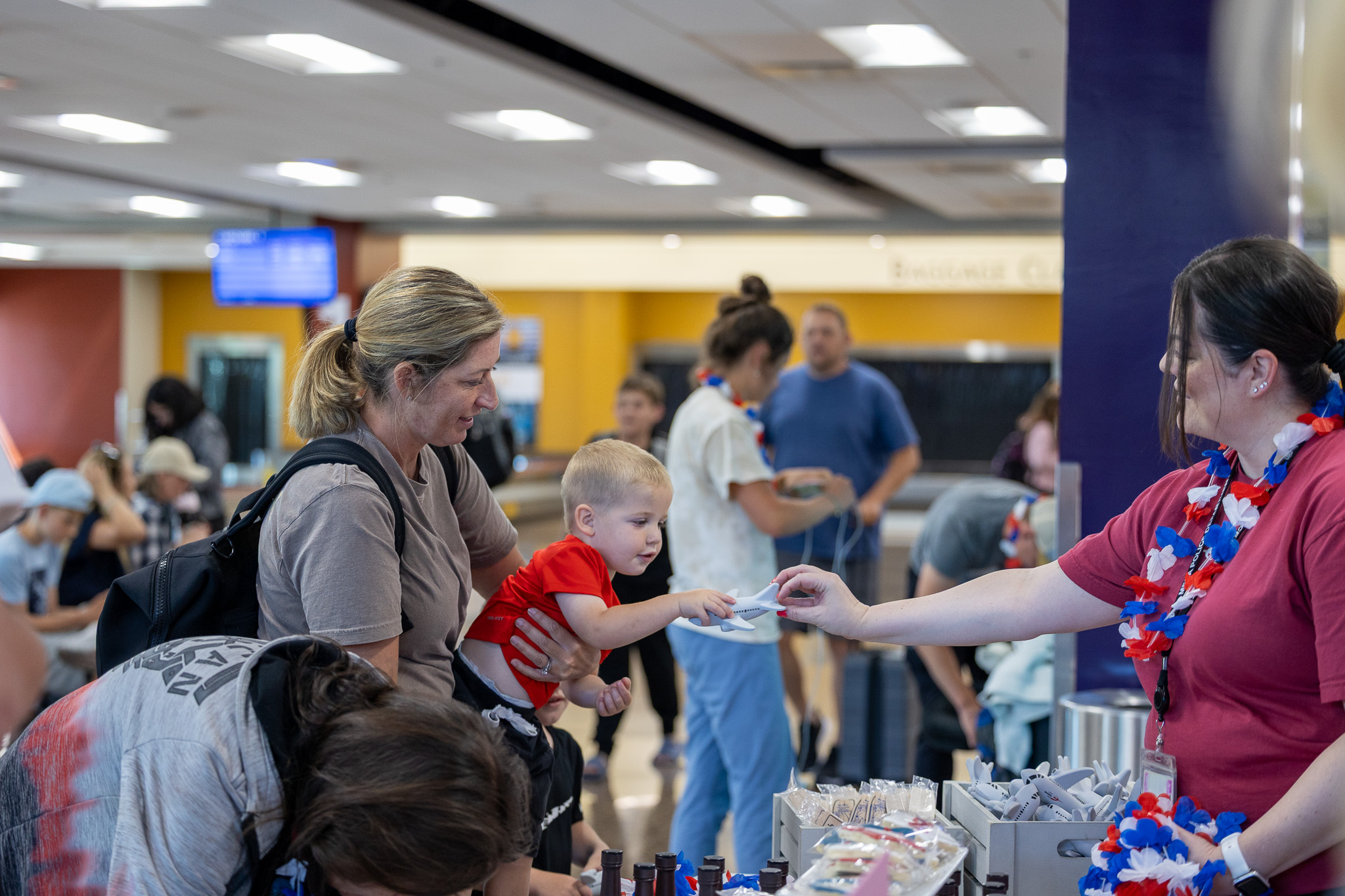
Community Relations
Mesa Gateway Airport is proud to be a vital part of our local, regional, and national air transportation network—and an active partner in the surrounding community. We value open communication with neighbors, businesses, civic groups, tenants, and other stakeholders.
Curious about how the airport operates, what’s happening now, or what’s planned for the future? Mesa Gateway Airport Authority (MGAA) staff is happy to meet with you to give a presentation at your event, provide a guided airport tour, or discuss a different idea you have. See below to find the best way to connect.
About Gateway Airport
Learn more about the rich history of Mesa Gateway Airport, dating back to the 1940s, by visiting our History and Mission page.
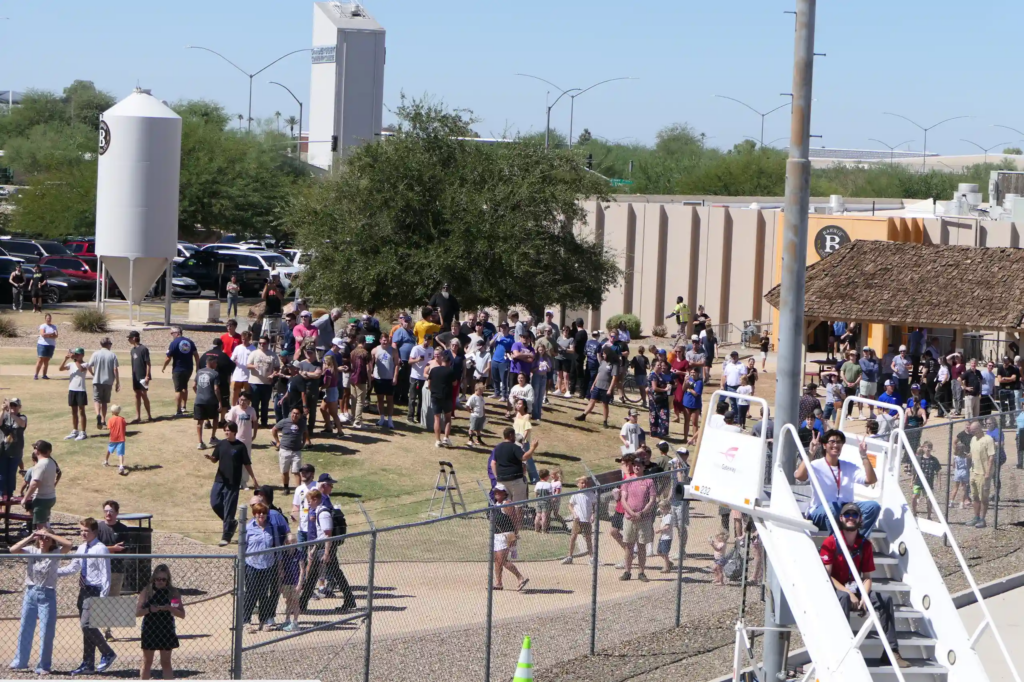
Aircraft Viewing Area – Lynn Kusy Park
Lynn Kusy Park is open to the public and offers an excellent vantage point for watching aircraft take off and land at Mesa Gateway Airport. The park features a spacious grassy area and benches, with Barrio Brewing Co. conveniently located adjacent to the park.
Public Presentations
MGAA seeks opportunities to participate in community events. If you would like a staff member to be involved in your next event or speak with your organization, please contact Kaylie Hankins, Community Relations Manager, at khankins@gatewayairport.com or +1 (480) 988-7618.
Aviation Noise Disclosure
If you’re buying or renting near the airport, it’s a good idea to learn about factors that may affect your property or quality of life—including aircraft noise.
Aircraft overflights can be a concern for nearby residents, even in areas outside formal airport noise contours. In Arizona, State law provides the rational basis for airport disclosure based on the Traffic Pattern Airspace map and 60 DNL noise contour. The map can be viewed on the Arizona Department of Real Estate’s website.
For many years, MGAA staff has worked with property owners around the airport to provide disclosure to prospective buyers via a noise disclosure map, surface street directional signage, and the Traffic Pattern Airspace Map on record with the Arizona Department of Real Estate. Some residential communities in the airport vicinity have provided noise disclosure information to the original homebuyers, placed disclosure information in the Community Codes, Covenants, & Restrictions (CC&Rs), or listed the airport under the “hazard or nuisance” section of the Subdivision Report on file with the County Recorder’s office.
Aviation Noise Roles and Responsibilities
MGAA plays a key role in the national and regional air transportation system and is committed to leading noise abatement efforts. Many different organizations share the responsibility for elements of a noise abatement program, and airport operators are just one of these responsible parties. The various participants in the aircraft noise abatement issues and their roles are as follows:
The Federal Government
The national air transportation exists today primarily through Federal legislation, and every facet is governed by Federal Aviation Administration (FAA) regulations. The FAA exercises control of aircraft noise through noise emission standards, air traffic control, pilot and flight regulations, and noise compatibility studies. More information is available on the FAA website.
State of Arizona
State regulation of aircraft in flight is preempted by federal law; however, state regulations do affect disclosure of aircraft flight paths and noise. Arizona Revised Statute 28-8486 Public Airport Disclosure requires the recording of public airport disclosure maps. The maps provide information to prospective homebuyers, as well as current homeowners.
Airport / Local Government
MGAA is responsible for promoting noise abatement procedures and ensuring compatible land development through zoning and stipulations within the Airport Influence Area. Airports cannot govern aircraft while they’re in the air, but we serve as the local point of contact for noise concerns. While not required to, we track noise complaints to facilitate dialogue with our community.
Pilots
Aircraft operators are responsible for operating their aircraft safely, while in compliance with Federal Aviation Regulations governing flight and Air Traffic Control instructions. The national and local pilot associations actively encourage their members to exercise noise abatement procedures whenever possible.
Residents
Current and prospective residents in areas surrounding or near airports should seek to understand aircraft noise and steps that can be taken to minimize its effects. Prospective home buyers should research the location of airports and flight paths, then make an informed decision before purchasing a home. Recognizing airports tend to increase in activity as more people move to the area (as freeways and surface streets increase in traffic over time, so do most airports), prospective area residents should acknowledge that flight paths can change and become busier over time.
Radar Flight Tracking
The City of Phoenix provides flight tracking as a service to Valley residents.
By clicking on the link, you will be leaving www.gatewayairport.com. Filing a noise complaint on this third-party page will not be forwarded to Mesa Gateway Airport. Please submit noise complaints for Mesa Gateway Airport here.
Please note:
- Flight information displayed is on a 10-minute delay due to security reasons.
- Flight altitudes are displayed as Mean Sea Level (MSL). Mesa Gateway Airport is at 1,381’ above sea level, so the number needs to be adjusted to determine the actual distance above the ground. For example, an aircraft showing an altitude of 3,381 feet over the airport would be flying at 2,000 feet above ground level.
Submit an Aircraft Noise Complaint
MGAA tracks aircraft noise complaints to identify patterns and trends, and to facilitate communication between pilots, the FAA, and community. Please note that noise complaints do not directly change flight paths nor result in violations against specific pilots in most cases.
To submit an aircraft noise complaint, please click the button below or call the Airport Noise Hotline at +1 (480) 929-7902.
All aircraft noise complaints submitted online or by phone are compiled and cumulatively reported into a monthly noise report that is submitted to the MGAA Board of Directors.
*Please note: information provided on the noise complaint hotline or online noise complaint form may be subject to a public records request. Submissions that include swearing, vulgarity, or threatening language will not be recorded.
Drone Operators
In light of the growing popularity of commercial and recreational unmanned aircraft systems (UAS), commonly referred to as drones, MGAA is advising operators of the procedures for authorization and safe operation.
The FAA has issued specific guidelines for the operation of both commercial and recreational unmanned aircraft. The guidelines include general operating rules, including altitude restrictions. If you intend to fly your drone within five miles of the airport, you must have an approved Certificate of Waiver or Authorization (COA) and comply with any coordination agreements indicated in your COA.
Automated Process
LAANC automates the application and approval process for airspace authorizations. Through automated applications developed by an FAA Approved UAS Service Suppliers (USS), pilots apply for an airspace authorization. This process is completed using your UAS Service Suppliers application or web page.
Requests are checked against multiple airspace data sources in the FAA UAS Data Exchange such as UAS Facility Maps, Special Use Airspace data, Airports and Airspace Classes, as well as Temporary Flight Restrictions (TFRs) and Notices to Airmen (NOTAMs). If approved, pilots can receive their authorization in near-real time.
Unless specifically requested in an authorization, drone pilots do not need to notify the tower before they fly.
LAANC provides airspace authorizations only. Pilots must still check NOTAMs, weather conditions, and abide by all airspace restrictions.
Manual Process
If your automated process was denied, it may be due to the requested altitude and/or location of requested operation. You may use the manual process by going to the FAA’s website and completing the required fields. The manual process may take up to 45 days to receive approval and may require specific communication requirements to Air Traffic Control.

Volunteer
Enjoy serving your community? Are you a people person? Join the MGAA Aviators Volunteer Program and provide a friendly and just plane easy® experience for our guests!
Aviators play a vital role at the airport by:
- Answering questions
- Providing directions
- Assisting guests
- Participating in special events
Interested in joining? Applicants should be:
- Able to pass a TSA/FBI background check for an airport security badge
- Have an outgoing personality
- Work well with others
- Be ready and willing to learn
Aviators are recognized for their service at various events and meetings throughout the year! If you’re ready to apply, visit our Careers page.